A business owner in Dubai usually asks three questions before starting: how much does the website cost, how long does it take, and what exactly will I receive? This article answers them in order.
What are you actually buying?
A website isn’t a count of pages. It is four things together:
- Design that gets the visitor to what they’re looking for in seconds.
- Development that makes the pages fast and working on every device.
- A control panel you use to edit the content yourself.
- Search engine optimisation that lets Google understand your pages from launch day.
Missing any one of them shows up later: a beautiful website nobody finds, or a website where you can’t change a price without going back to the developer.
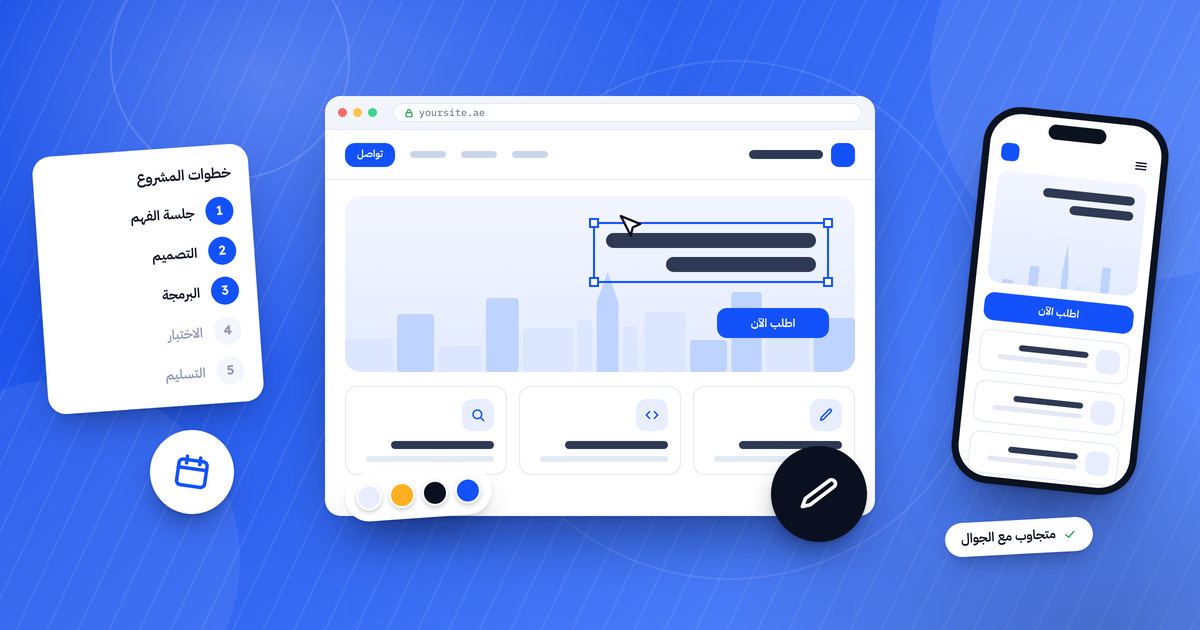
The five steps
- Discovery session: your business, your client, and what you want the visitor to do. You come out with a written scope: pages, features, timeline and price.
- Design: the interfaces are presented to you for approval before a single line of code is written. This is where changes are cheapest.
- Development: the approved design becomes a real website with a control panel.
- Testing: on phones, computers and browsers, with checks on speed, security and links.
- Handover and training: you receive all the logins and are trained to run the site.
The details are on the Website Design & Development page.
Ready-made template or custom design?
| Ready-made template | Custom design | |
|---|---|---|
| Start | Faster, because the look already exists | Slower, because the interfaces are drawn for your business |
| Look | Repeated on other websites | Unique to your brand |
| Speed | May carry code you don’t use | Written only for what you need |
| Expansion | Limited by the template | Open |
A template isn’t a flaw in itself. A simple company website on a limited budget may be fine with one. But ask before you pay: is what I’ll receive designed for my business, or a template with its colours changed? The two prices can’t be compared.
What determines the cost?
The price follows the scope of work, not the number of pages. The biggest factors:
- A custom design or an edited ready-made template.
- A company website or a store with products, payments and shipping.
- One language or more.
- Whether the domain, hosting and SSL certificate are included in the price.
- Whether you need a brand identity or a mobile app with the website.
That’s why prices on the market vary so widely. A fair comparison is between two identical scopes, not between two numbers. Our prices are published on the Packages page, starting from AED 2,099 for the Basic package. For more detail, read How Much Does Website Design Cost in the UAE?.
Arabic and English together
Dubai audiences search in both languages. If your clients do too, decide from the start, because adding a language after handover costs more than building it with the website.
- The Arabic page isn’t a mirrored copy of the English one. Fonts, alignment and icon direction all need reviewing.
- Each language has its own separate URLs, with hreflang tags so Google shows the right version to each searcher.
- Machine translation without review does more harm than good.
For an existing website: Adding a Language to Your Website.
When does the timeline start?
From the day the content is received, not from the day of signing. What delays projects most isn’t development but waiting for text, images and approvals. Prepare before you start:
- Your logo and a short description of the business.
- The list of services or products with their prices.
- Real photos of your business.
- Contact details and social media accounts.
Mistakes that cost you later
- Registering the domain in the designer’s name “temporarily”. Temporary drags on, and getting it back needs their consent.
- A verbal agreement on features. Write every feature into the scope of work.
- Judging the design on a computer screen alone. Try it on your phone before approving.
- Leaving the content until after development. Content changes the design, not the other way round.
- Launching a website that takes online payments without published policies.
Questions to ask before signing
- In whose name are the domain and hosting registered? The right answer: yours.
- Is there a monthly subscription after handover?
- How many revisions am I entitled to, and at which stage?
- What does support after launch include, and for how long?
- Is the website optimised for search engines, and what exactly does that mean?
Ask for the answer to each question to be written into the contract. What isn’t written down is hard to rely on later.
Quick questions
Isn’t an Instagram account enough instead of a website?
An account introduces you, but it belongs to the platform and is governed by its rules. A website is yours, appears in Google search, and holds your prices, policies and payment methods the way you want.
Should I start with a small website and grow it later?
Yes, if it’s built on a foundation that allows growth. Ask about this directly: can a store, a language or an app be added later without rebuilding?
When will I see the website during the work?
At every approval stage: the design first, then a working preview before launch.
After launch
A website needs ongoing care: updates, backups, and keeping an eye on what visitors search for. Go through The Pre-Launch Website Checklist, then connect your website to Search Console as explained in the knowledge base.
Need what you just read put into practice?
Our prices are published: packages for every project size, and stand-alone services you can order on their own.